https://www.ketv.com/article/nebraska-voter-registration-data-felony-convictions/63205376
By JustUs15Vote
Since 2005 via LB 53 (restoration of voting rights after two-years of completion of a felony
sentence), more than 90,000 Nebraskans already had their right to vote restored over the past 19 years. With the passage of LB 20 (automatic voting restoration upon completion of a felony sentence) in 2024, those numbers will continue to increase.
The Missouri bill mentioned in the article proposes that convicted felons should be allowed to run for public office, using the case of Donald Trump—who, despite facing legal challenges, is allowed to run for and become president—as a key argument. This can’t just be an exception for Trump. Applying this reality to Nebraska, if Trump can, we certainly should be able to as well. Nebraskans convicted of a felon should be allowed to hold public office and serve on jury for
several reasons:
1. Equal Rights Under the Law: The argument that Trump is entitled to run for and become president, despite legal challenges, highlights the principle that individuals,
regardless of their past actions, keep certain fundamental rights. If a person who has been
convicted of a crime has served their sentence and completed their legal obligations, they
should not be further deprived of their civil rights. These rights include the ability to take
part in democratic processes, such as running for office or serving on a jury. Denying
these rights suggests a perpetual punishment beyond the original sentence, which goes against the idea of rehabilitation.
2. Rehabilitation and Reintegration into Society: Allowing convicted felons to hold public office or serving on juries supports the principle of rehabilitation. By enabling
citizens convicted of a felony to take part in these civic duties, the state sends a message
that individuals can change and contribute positively to society. Their experience and
perspective could enrich public service, making decisions that are more reflective of the
full diversity of the community.
3. Precedent Set by High-Profile Figures: The case of Donald Trump, as cited in the
Missouri bill, serves as a precedent. If a high-profile individual facing legal challenges can still take part in the political process, why should an ordinary citizen who has paid
their debt to society be denied the same opportunity? This could be interpreted as a
contradiction in how the law treats different individuals, and a fair and consistent
application of rights would support allowing citizens convicted of a felony in Nebraska to hold office and serve on juries.
4. Second Chances and Democracy: A functioning democracy is one that offers second chances. Allowing citizens convicted of a felony to run for office and serve on juries
provides them with an opportunity to prove they are habilitated and trustworthy members of the community. This aligns with the principles of democratic inclusion and redemption, where the past should not indefinitely prevent someone from taking part in
society’s important decisions.
5. Voter and Jury Representation: Citizens convicted of a felony, as a significant demographic, can offer valuable perspectives in decision-making roles. In many instances, they may be marginalized groups whose experiences are often
underrepresented in political discourse and jury pools. Allowing citizens convicted of a
felony to serve in these roles ensures that government decisions and legal outcomes better reflect the diverse reality of the population.
By citing the obvious example of Trump in Missouri, the argument can be made that citizens convicted of a felony in Nebraska should be allowed to run for office and serve on juries, not only as a matter of fairness but also as a way to strengthen the democratic process by fostering inclusion, rehabilitation, and equal treatment for all citizens.
See source article:
https://missouriindependent.com/2024/12/09/missouri-gop-lawmaker-
invokes-trump-in-bill-to-allow-felons-to-run-for-office/
Nebraska currently utilizes a system known as the congressional district method for awarding its five electoral votes. This system allocates one electoral vote to the winner of each of the state’s three congressional districts, with the remaining two electoral votes going to the candidate who wins the overall popular vote in the state. This approach is often seen as more reflective of Nebraska’s diverse political landscape compared to the winner-take-all (WTA) method used by most other states. Nebraska and Maine are the only states without a WTA method.
Here is the hit list of reasons why Nebraska should not adopt a winner-take-all (WTA) approach for awarding electoral votes:
Additionally, WTA systems tend to reward the dominant party, currently Republicans in Nebraska, and further entrench the two-party system, often making third-party candidates or independents even more unlikely to succeed. As a result, voter engagement could decline because individuals feel their votes have less impact if they know the outcome is already heavily skewed toward one of the two major parties.
This could result in less competitive elections overall, as candidates would focus only on a small subset of voters while ignoring larger parts of the country that may not be seen as “decisive.” Moreover, it would exacerbate the sense of a “nationalized” election where local concerns are subordinated to national party politics, further distorting the role of state-based electoral systems.
If Nebraska were to switch to a WTA system, its five electoral votes would essentially become a “winner-takes-all” prize, making it less likely that any candidate would focus on Nebraska as a key battleground state. This could lead to a situation where the state’s voters are largely ignored, as presidential candidates would spend most of their resources targeting the larger, more competitive states. In this scenario, Nebraska’s electoral votes would have less importance in the broader context of the national election.
This could diminish the state’s ability to prioritize local issues that may not receive attention in a national WTA context. It could also lessen the degree to which Nebraskans feel that their votes are directly contributing to the election outcome, reducing voter turnout and engagement.
Conclusion
I know of no competition where the winner of the contest is automatically awarded all the other points from their opponent. You win the contest based on what you earned and no more. While the idea of adopting a winner-take-all electoral system might appear appealing in terms of simplicity and reflecting a clear mandate, it carries with it numerous significant downsides that would harm Nebraska’s democracy and the electoral process.
The current congressional district method provides a more equitable distribution of power, encourages candidates to engage with a wider range of voters, and helps to ensure that the diverse political voices within the state are heard. Switching to a WTA system would undermine these benefits, disproportionately favor one side of the political spectrum, and diminish the influence of Nebraskans’ votes on the national stage. As such, it is a decision that would likely weaken, rather than strengthen, Nebraska’s role in presidential elections. If the electoral college must be used, it should never be done on a WTA method, especially in Nebraska. Nebraskans don’t let this happen, contact your state senator and request that they don’t support, entertain the idea, and certainly not vote for a WTA change in Nebraska.
By,
Shakur Abdullah (JustUs15Vote)

#VoterRegistration #Vote2024 #votingmatters #VotingRights #vote #voteyourinterest
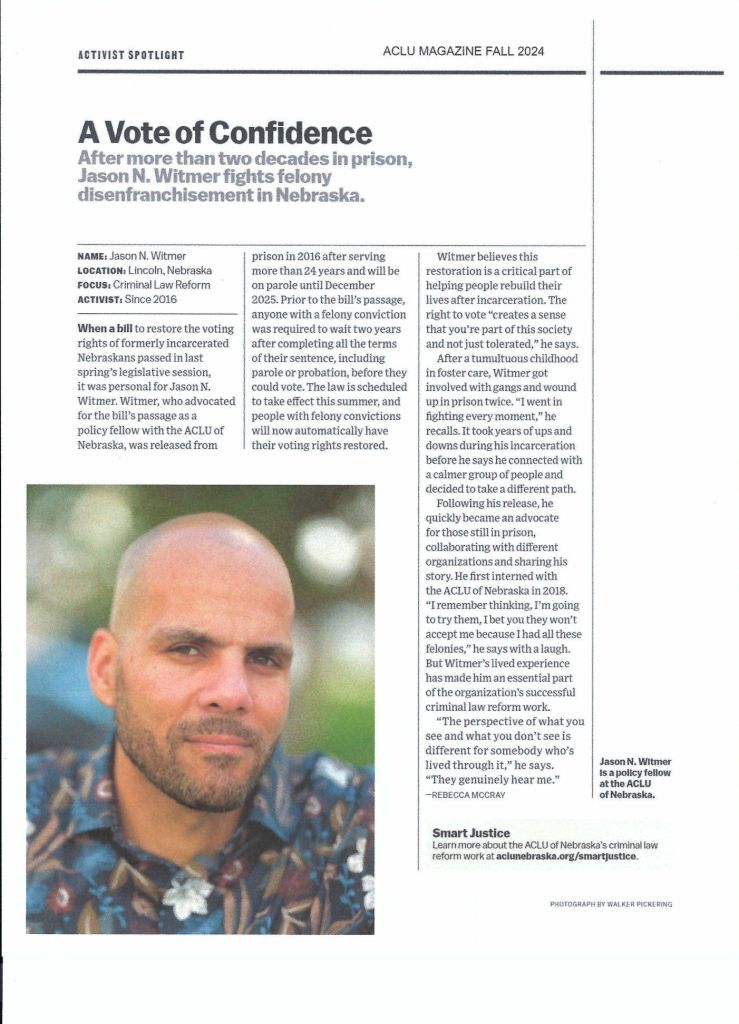
We are thrilled to announce a monumental victory for democracy in Nebraska! The Nebraska Supreme Court has ruled against Secretary of State Bob Evnen’s unjust interpretation of voting rights for Nebraskans with felony convictions. This ruling affirms that citizens who have completed their sentences can now register to vote and participate in the upcoming election via LB 20, which became operative on July 18, 2024.
This important decision marks a significant step forward in restoring voting rights to many Nebraskans. However, it is crucial to recognize that this victory is partial. Those citizens currently serving felony sentences, including probation and parole, remain disenfranchised, and our fight for their rights will continue.
Now is the time for action! If you have completed your sentence and are “off paper,” we urge you to register immediately and make your voice heard through your vote in the upcoming elections. Every vote matters, and your participation is essential to demonstrate what a vibrant democracy looks like.
Together, let’s ensure that every Nebraskan’s voice is heard through their vote and that democracy reflects the will of all its citizens.
To learn more about your rights and how to register, we encourage you to visit these helpful resources:
WHERE:
Nebraska Supreme Court Courtroom, 9:00 a.m., located within the Nebraska State Capitol in Lincoln, Nebraska
LIVESTREAM DETAILS AVAILABLE HERE:
https://supremecourt.nebraska.gov/courts/supreme-court/supreme-court-call

 justus15vote